Custom Bag Manufacturer in China for OEM/ODM Projects
Yunshengyuan's bag workshop is in Yuexi County, Anqing, Anhui, China. Send a drawing, sample or product idea; we'll review the bag category, construction and customization scope. Final specifications and commercial terms are confirmed for each project.
OEM inquiry: share your existing design, drawing, specification sheet or sample and explain which requirements must be followed.
ODM discussion: describe the use, target customer, desired function and design direction. The team can review suitable catalog references and the changes your project may require.
In both cases, the catalog is a reference for discussion. Final construction, materials, dimensions and production terms are confirmed against the agreed specification and sample.
START WITH WHAT YOU HAVE
Not every detail needs to be decided yet.
A product photo, sketch or reference sample can help begin the discussion. Add the target quantity and destination if known; open questions about size, material or branding can be clarified during review.
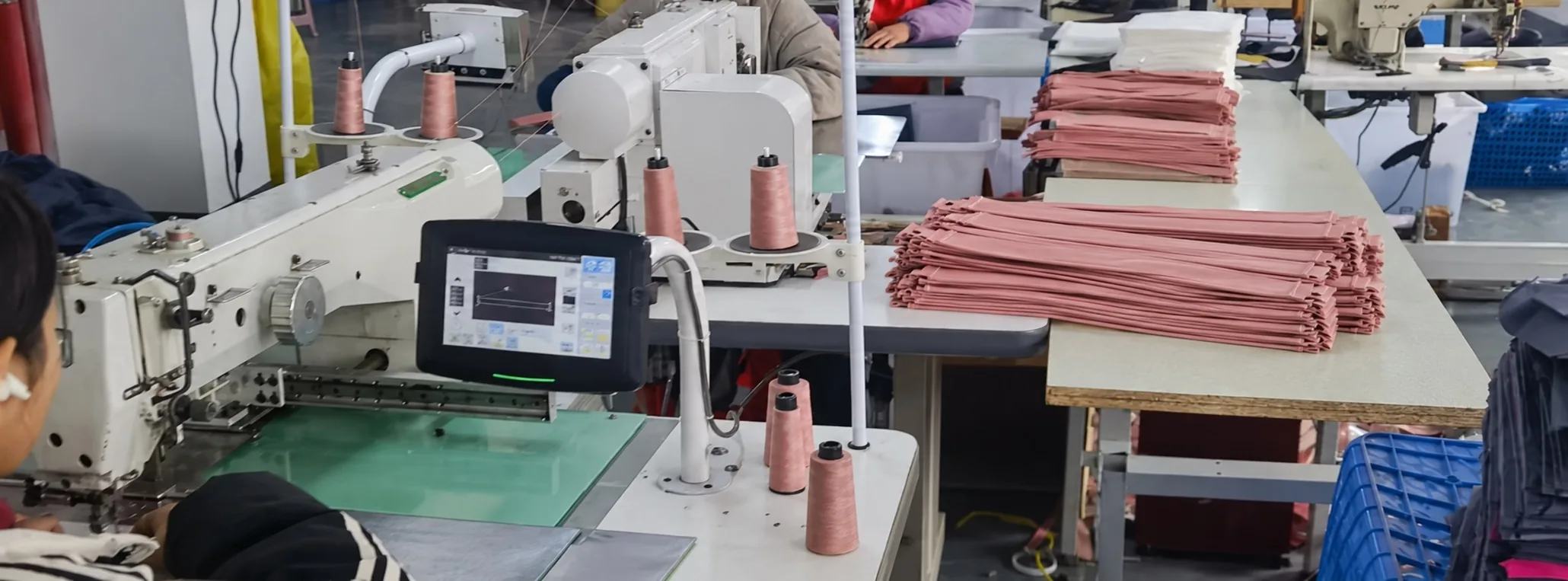
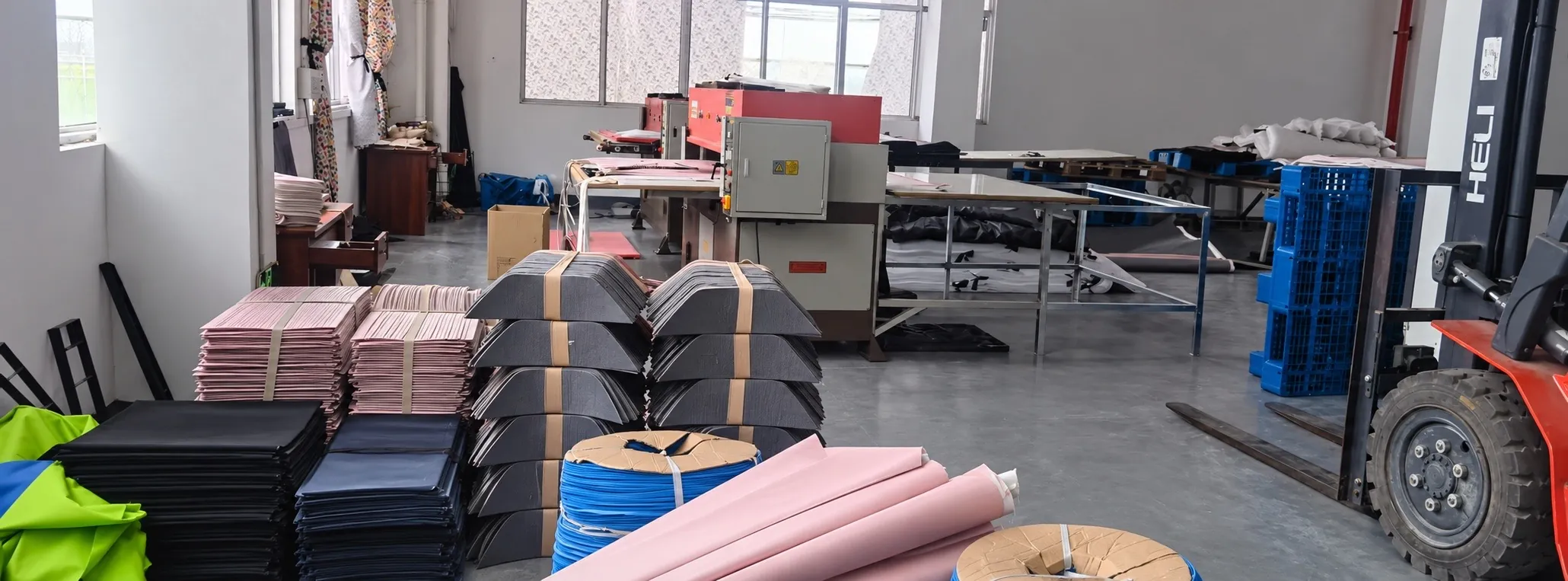
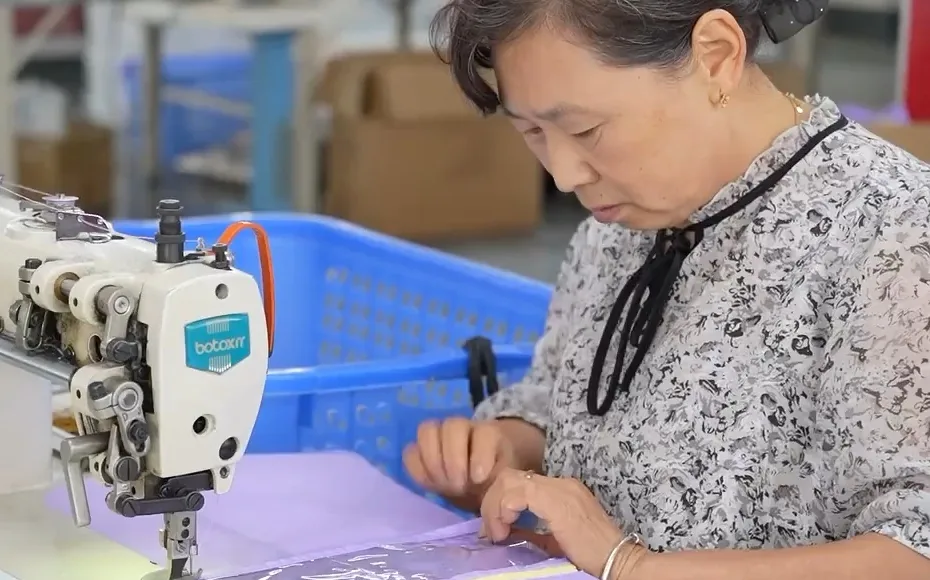
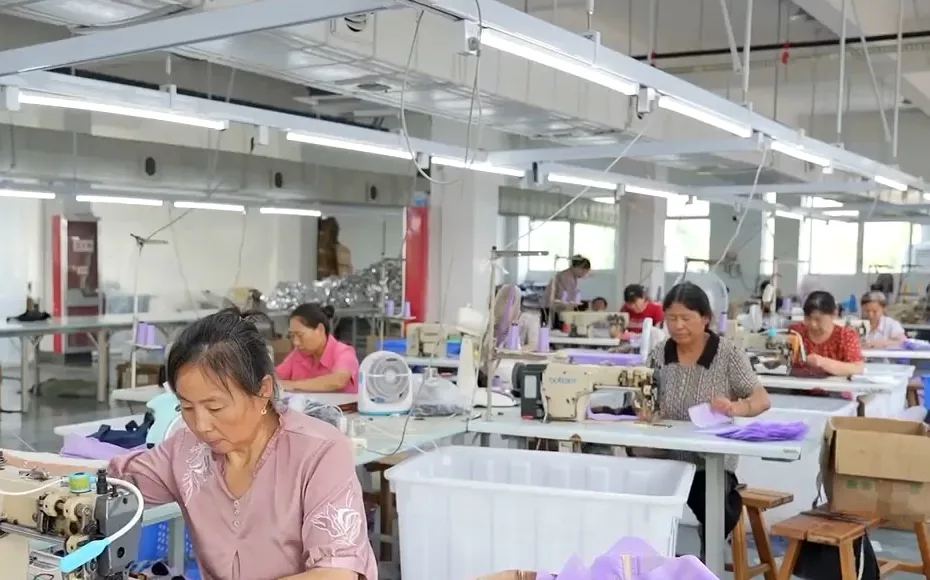
These workshop views show material preparation and sewing work. They help buyers discuss construction details; the production plan, equipment assignment and capacity for an order are confirmed for each project.
Material panels prepared for sewingSewing a bag componentMultiple sewing workstations
A general example of handling cord at a fabric pouch opening; not our workshop or a specific product. Cord and channel details depend on the approved sample.
Transcript
A cord is handled at the opening of a fabric pouch. Cord size and channel details depend on the design and approved sample.
Bag edge finishes: binding, piping and edge paint
These are different construction choices. The right option depends on the panel material, seam position, intended appearance and approved sample.
Binding
A strip wraps a cut edge and is stitched in place. Discuss the tape material, finished width, colour and how it follows corners or curves.
Piping
A narrow raised trim runs along a seam; some constructions use a cord inside a covering strip. Specify where it runs, the visible profile and the trim colour.
Edge paint
A coating is applied along an exposed cut edge. Discuss surface compatibility, colour and the finished appearance on the chosen material.
What to include in your bag brief
Mark the exact edge or seam on a photo or drawing and specify whether the trim is visible inside or outside.
Share a colour reference and preferred strip, cord or finish; review how it looks around curves and joins.
Confirm the method, placement and finish on the approved sample; performance requirements and tests must be agreed separately.
General demonstration, not our workshop or a specific bag. Methods depend on design and sample.
A folded fabric edge is guided under the sewing machine. Binding method and material should be confirmed for each bag design.
Webbing bar-tack stitching
General demonstration on a webbing sample. Placement and stitch details depend on the design and approved sample.
Bar tacks create concentrated stitches on a webbing sample. Placement and stitch details depend on the bag design and approved sample.
Multi-needle quilting
A general quilting demonstration. Materials and stitch patterns depend on the approved sample.
Multi-needle quilting creates a stitched pattern across layered fabric. Materials and stitch patterns are confirmed for each project.
Automatic zipper equipment
General equipment demonstration: zipper tape and finished pieces are visible; slider insertion happens inside the machine.
Factory footage: guided sewing
An operator positions material in a guide while the machine sews the panel. Methods depend on the approved design and sample. Captions available.
Video transcript
An operator positions material in a guide while the machine sews the panel. The exact construction depends on the approved design.
Bag hardware attachment
A general demonstration from outside our workshop. Hardware style, position and finish are confirmed for each project and approved sample.
Video transcript
A metal fastener is positioned and secured to a bag component with a hand tool. Hardware style, placement and finish depend on the design and approved sample.
Bag edge colouring
A general demonstration from outside our workshop. Edge coating, material compatibility and colour are confirmed for each project and approved sample.
Video transcript
Edge finishing applies a controlled coat along the cut edge of a bag component. The finish and colour are selected according to the material and approved sample.
Material press demonstration
A general material-press example from outside our workshop. The visible result and specific process must be checked separately; material, tooling and finish depend on the project and approved sample.
Video transcript
A press applies pressure to a material surface. For each bag project, confirm the material, tooling and final finish on a sample.
Find a starting category
Explore Yunshengyuan catalog references, then share the product details that matter to your project.
Across 37 Yunshengyuan catalog products with visible Alibaba.com minimum-order listings checked on November 1, 2026, 12 listings show 100 units, 24 show 500 units, and 1 shows 1,000 units. The displayed unit name varies by listing. These dated catalog references are not a blanket minimum for custom projects; confirm the MOQ for the selected style and specifications.
What to include in a custom bag RFQ
A useful inquiry helps both sides discuss the same product and order scope. Send the details you already have; mark anything still undecided.
Product and use: category, intended contents, use environment and target buyer.
Size and construction: finished dimensions, compartments, closure, handles or straps, and reference photos or drawings.
Material and finish: outer material, lining, color, hardware and any required hand-feel or appearance.
Branding and packing: logo artwork, placement, label, decoration method and individual packaging request.
Order scope: estimated quantity per style or color, destination, target timing and whether a sample is requested.
Missing some specifications?
Send the product reference and the target use first. Ask us which dimensions, materials or artwork details still need to be confirmed before a comparable quotation can be prepared.
MOQ can vary with the bag design, material, colors and customization process. Include an estimated quantity per style or color so the team can review the project requirements.
Can I request a sample before placing an order?
Samples can be developed from customer artwork or requirements. Include the sample request; availability, sample cost and timing depend on the selected design and project scope and should be confirmed before proceeding.
Can I customize dimensions, materials, colors and logo?
Share your target requirements and artwork. Feasible options, construction changes and any cost impact are reviewed for the selected model and confirmed against the sample.
How are price and lead time determined?
The schedule depends on the approved specifications, quantity, materials, branding, packaging and destination. Sampling, material preparation, bulk production and shipping are reviewed separately; the applicable milestones and dates are confirmed for each project.
Are catalog specifications final?
Catalog pages are starting references. Confirm dimensions, materials, lining, capacity, performance requirements and commercial terms for the selected project before approving a sample or order.
Review pattern layout, material preparation, cutting, decoration, sewing, zipper fitting, binding, lining, inspection and packing. Each operation depends on the selected bag construction, so use the approved sample and written specification as the project reference.
Share artwork, placement and the chosen material so print appearance can be reviewed on a sample.
CUSTOM BAG PROJECT / INQUIRY
Tell us what you want to make.
Share the details you already know. We can review construction, materials and customization options with you; final specifications, quotation and timing are confirmed for each project.
A useful brief can include the bag type, dimensions, material, color, logo, packaging, target quantity, destination and timing. Leave undecided details open.
For artwork or reference files, contact us by email or WhatsApp.
General fabric-inspection demonstration, filmed outside Yunshengyuan. It shows a roll being checked before cutting; it is not a test report for Yunshengyuan materials or finished bags.
Agree visible shade and surface criteria against the approved reference. Record material lot, colour reference and any variation limits before bulk cutting.
Pattern layout before cutting
Paper patterns are arranged on material before cutting. Specify the material, grain or print direction and placement when discussing a sample.
General process demonstration; the material and method depend on the project.
Zipper slider fitting
A slider is positioned on zipper tape. For a custom project, discuss the zipper type, puller style and colour, then check compatibility and smooth movement on the approved sample.
General process example; details depend on the project.
Measuring a bag sample
Agree on the measurement points and method, then check width, height and depth against the approved sample. State any tolerance for the project.
General demonstration in a sample-showroom setting; this does not document factory inspection.
Print and logo methods for custom bags
Discuss the artwork, material and sample before choosing a method. Availability depends on the project.
Digital textile printing
Useful to discuss for multicolour artwork. Confirm the fabric, artwork size, repeat and colour against a sample.
Heat transfer
A printed or cut design is applied using heat and pressure. Confirm material compatibility and the transfer supplier’s time, temperature and pressure instructions.
Screen printing
Ink passes through a prepared screen onto the surface. Share the number of colours, print size and placement for review.
Send vector artwork or a clear image and mark the position on the bag. Agree on sample review and any requested testing.
Digital printing demonstration
General process example with synthetic narration. Confirm material and artwork against the approved sample.
Digital printing applies artwork to a surface. Confirm the material and design on your sample.
Screen printing demonstration
Generic process illustration; not filmed at Yunshengyuan and not specific to one bag style.
Ink, surface, artwork and placement must be confirmed on the approved sample for each project.
Handwork near a leather bag zipper
An artisan works by hand near a zipper on a leather bag. Placement and finishing depend on the design and approved sample.
General demonstration by another workshop; not a record of this factory or a specific order.
PRODUCTION DETAILS
Bag reinforcement, lining and finishing checks
A custom bag factory guide to three details that shape construction: reinforcement placement, lining assembly and sample-based finishing checks. The exact method depends on the bag design, materials and approved sample.
Reinforcement at stress points
Handle roots, strap joints, hardware openings and the base may need added support according to the design. Options can include a reinforcement patch, webbing, a reinforced seam or a material-compatible bonding method. Check placement and seams against the approved sample; do not infer a load rating without an agreed test.
Lining assembly and pressing
The lining may be assembled separately, joined to the shell, turned and closed according to the construction. Pressing temperature, pressure and protective layer must be checked on the actual material first, especially for PU, PVC and laminated surfaces. Review wrinkles, fabric caught in the zipper, exposed edges and fit.
Finishing checks against the sample
Compare dimensions, symmetry, stitching, binding or piping where specified, zipper movement, hardware, logo position, lining and packaging with the approved sample. Any performance test needs an agreed method and acceptance criteria.
Process questions
How do bag manufacturers reinforce handles and strap attachment points?
The reinforcement method depends on the bag design, material and approved sample. A handle root, strap joint, hardware opening or base may use a reinforcement patch, webbing, stronger stitching or a compatible bonding method. Confirm the construction and any load test separately.
How is a custom bag lining assembled and pressed?
Lining panels may be sewn separately, joined to the outer shell, turned and closed according to the pattern. Check the actual fabric before pressing: heat, pressure and a protective layer vary by material, especially for PU, PVC and laminated surfaces.
What should buyers inspect on a finished custom bag sample?
Compare the sample with the written brief for dimensions, symmetry, seams, specified binding or piping, zipper operation, hardware, logo placement, lining and packaging. Agree on any performance test and acceptance criteria before production.
For a project review, share the bag type, drawing or sample, outer fabric, lining, padding or reinforcement points, closure and hardware, logo, quantity, destination and packaging needs. No universal heat setting or performance result is assumed.
Decoration, 3D logo and padding options for custom bags
Choose a process around the bag surface, artwork, intended feel and construction. Share the artwork and material reference; confirm feasibility and appearance on the approved sample before bulk production.
Hotfix rhinestones
Hotfix stones use heat-activated adhesive. Temperature, pressure and dwell time must suit the specific surface. Review the layout and test on the actual material first, especially on coated or heat-sensitive panels.
What does “3D logo” mean?
The term can refer to different methods: 3D puff embroidery uses foam beneath stitches; raised silicone or TPU transfers use a molded or layered mark; embossing presses a relief into a compatible surface. They are not interchangeable. Confirm artwork, material and method on a sample.
Padding versus shape support
Soft padding cushions; firm interlining or board helps a panel hold shape. Tell us the intended use, preferred hand feel, target thickness and usable inside dimensions. The material stack and final capacity need sample review.
Process questions
Can hotfix rhinestones be applied to any bag material?
No universal heat setting suits every surface. Heat-sensitive coatings and films may change during application. Test the proposed stone, adhesive, temperature, pressure and dwell time on the same material before approving the sample.
Is a 3D logo the same as 3D printing?
Not necessarily. Bag decoration may use foam-backed 3D puff embroidery, raised silicone or TPU transfer, or embossing. Specify the visual effect and artwork, then confirm the process on the intended panel.
How should I choose padding for a custom bag?
First distinguish cushioning from shape support. Share the use case, desired feel, approximate thickness and required internal space; review the chosen layer combination on a sample.
Private-label bag manufacturer: prepare your OEM/ODM brief
A private-label bag project can start from a catalog style, buyer sample or drawing. Tell us how your brand should appear and which details still need review. Final construction, materials, label, logo method, MOQ, price, lead time and packaging are confirmed for the selected project and approved sample.
Brand assets: Share production artwork, label or patch type, position, size and brand colors.
Bag construction: Identify the style, target dimensions, outer and lining materials, closure, pockets, straps and hardware.
Order plan: Note quantity by style or color, sample needs and packaging requirements.
Open decisions: Mark each item as confirmed or still to be reviewed; material compatibility and final appearance are checked on the sample.